
English| EUR
Suggested for you
More currencies
Choose a language
Valencia's compact layout and extensive pedestrian zones make it one of Spain's most walkable cities. The historic center, riverside gardens, and beachfront promenade connect through dedicated walking routes. This guide covers distances, surface conditions, and the practical realities of navigating Valencia on foot.
Quick answer
Valencia is highly walkable. The Ciutat Vella historic district measures roughly 2 kilometers across, and most major attractions—from the Cathedral to the Central Market—sit within a 20- to 30-minute walk of each other. Dedicated pedestrian streets cover much of the old town, and the Turia Gardens provide a continuous car-free corridor linking the city center to the City of Arts and Sciences. Summer heat between June and September can make midday walking uncomfortable, but morning and evening temperatures remain manageable.
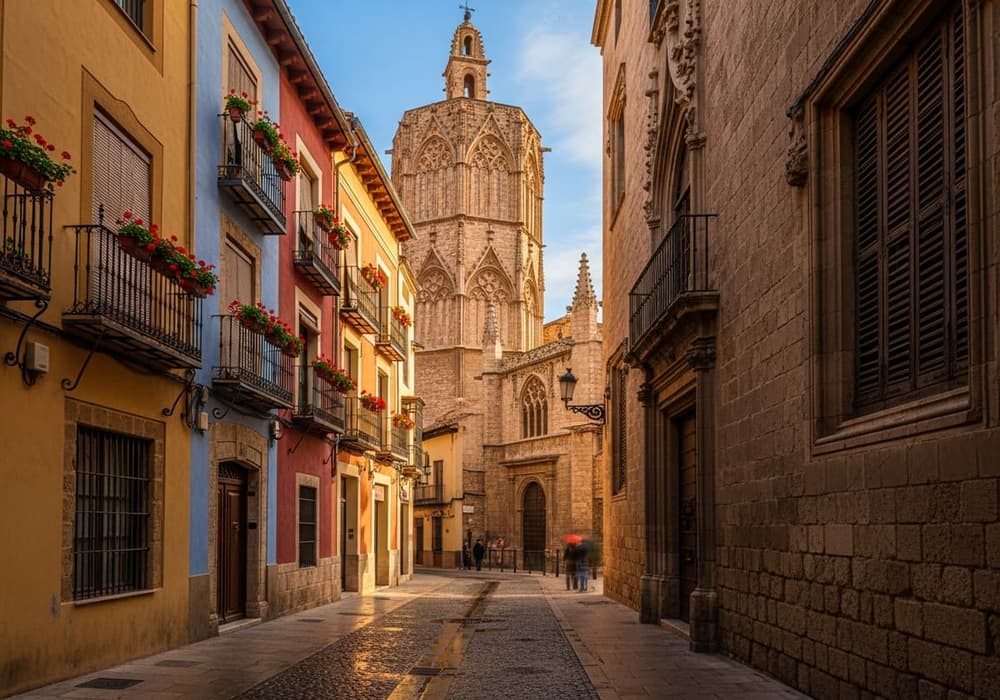
Valencia eliminated a six-lane elevated highway in the 1980s and converted the dried Turia riverbed into nine kilometers of continuous parkland. That single infrastructure decision reshaped how visitors move through the city today. The historic core—Ciutat Vella—occupies a tight grid bounded by remnants of medieval walls. Plaza de la Virgen, the Cathedral, and the Silk Exchange cluster within 400 meters of one another. The Central Market sits 300 meters west. Pedestrian streets dominate the district, and most vehicle access is restricted to service deliveries before 11:00. Cobblestone surfaces are common in the oldest lanes around Barrio del Carmen, but the main arteries use smooth pavement. The question of whether Valencia is walkable depends less on distance than on temperature: July and August afternoon heat regularly exceeds 35°C, and shade is sparse outside the Turia Gardens. The Turia park itself functions as the city's pedestrian spine. Cyclists, runners, and walkers share wide paths shaded by ficus and palm groves. The route stretches from Bioparc in the west to the City of Arts and Sciences in the east—roughly 7 kilometers end to end, though most visitors walk only the 3-kilometer central section linking Serranos Gate to the Palau de la Música. Bridges cross the park at regular intervals, connecting neighborhoods on either side without requiring a detour to street level. Beyond the historic center, the Russafa district lies 1.5 kilometers southeast—a 20-minute walk along tree-lined avenues. The beachfront at Malvarrosa sits 3.5 kilometers from Plaza del Ayuntamiento, reachable on foot but more commonly accessed by tram or bike. Public drinking fountains appear every few blocks in the old town, and most plazas offer shaded benches. Pedestrian crossings use timed signals, and drivers generally yield at zebra stripes, though intersections near the port and main ring roads demand caution. The streets are flat—elevation change across the entire city center is less than ten meters—so stamina matters more than fitness. Walking Valencia on foot is practical and common, provided you plan routes before midday heat peaks and carry water during summer months.
“The Turia Gardens provide a continuous car-free corridor linking the city center to the City of Arts and Sciences.”
To optimize your experience on foot, the best arrival window is 09:00–11:00. This period allows you to navigate the historic center before the onset of mid-day heat and peak pedestrian congestion.
Mild temperatures (15°C–23°C). Ideal for long walks without excessive heat.
Hot and humid (25°C–30°C+). Limit walking to early hours.
Comfortable (18°C–25°C). Enjoyable conditions for extended exploration.
—. Strategic timing to avoid mid-day heat and peak congestion.
Verdict: The best slot for walking is between 09:00–11:00 during the months of April, May, or October.
Valencia features flat, compact terrain that makes it highly accessible for pedestrians and those using mobility aids. A high percentage of the historic center and public spaces are pedestrianized, providing a seamless experience for visitors on foot.
Most streets are flat with dropped curbs facilitating smooth movement throughout the city center.
Major public areas and the Turia Gardens park system are designed to be entirely accessible.
Public facilities are available in parks and main tourist hubs, though some historic venues may have limitations.
Tactile paving and audible signals are standard at major intersections in the city center.
Visit during the best arrival window of 09:00–11:00 to navigate pedestrian areas with fewer crowds.
Valencia is located at Valencia, Spain, and serves as a central hub for pedestrian exploration. Most visitors arrive via major transit links before transitioning to foot to navigate the historic center.
Renfe to València-Nord Station
Line 3 or 5 to Xàtiva Station
EMT Valencia to Ayuntamiento stop
Direct to central district
For the most efficient start to your walking tour, head to the historic center between 09:00–11:00. Should you require assistance or local transit information upon arrival, contact +34963667415 or visit https://www.visitvalencia.com.
This half-day route connects Valencia's most pedestrian-friendly zones in a logical loop, suited to visitors who want to experience the historic core and waterfront without backtracking. Budget four to five hours at a comfortable pace, including stops.
Start at Plaza de la Virgen and walk the tight lanes around the Cathedral and La Lonja. Most streets here are pedestrianized, and morning light keeps the stone facades cool.
Head south through Mercado Central, then east along Carrer de Xàtiva toward Plaza del Ayuntamiento. Wide pavements and frequent shade make this stretch easy on foot.
Enter the former riverbed park at Puente de las Flores and follow the green corridor west. The path is flat, paved, and lined with bridges offering views of both banks.
Exit the park south into Russafa's low-traffic grid of cafés and independent shops. Streets are narrow but walkable, with plenty of benches and plazas for rest stops.
Access to the public city streets and pedestrian areas of Valencia is free for all visitors. There are no admission costs associated with walking through the historic center.
Verdict: A typical adult pays 0 EUR to walk through Valencia, as public streets and pedestrian areas remain free of charge.
Everything you need to know about is valencia walkable
Yes, Valencia is highly accessible on foot, particularly within the historic Ciutat Vella district. Many major points of interest are located close together, allowing visitors to navigate the city comfortably without constant need for transport. Understanding if Valencia walkable metrics apply to your route helps in planning a seamless trip.
The recommended arrival window is between 09:00 and 11:00 to avoid mid-day heat and peak pedestrian congestion in the center. Starting early ensures a more relaxed experience while navigating local streets. This timing is essential for those wondering is Valencia walkable during warmer months.
Public city streets and pedestrian areas are free to access, requiring 0 EUR for entry. This makes self-guided exploration of the urban landscape very affordable. You do not need to pay admission fees just to stroll through the city center or public squares.
The city is well-suited for families because it features many flat, car-free zones and extensive park areas like the Turia Gardens. Its compact nature means that a pedestrian city tour is manageable even with children. Most visitors find that is Valencia walkable in its design, which supports a slower, more enjoyable pace.
The most effective method is to utilize established city walking routes that connect plazas, cathedrals, and markets. By focusing on these distinct pedestrian paths, you can easily reach various landmarks without navigating heavy traffic. Engaging with a guided tour can provide deeper context regarding the local heritage and urban layout.
Valencia features a blend of narrow medieval lanes and wide boulevards that were designed for easy movement. The absence of steep hills makes traversing the city physically undemanding for most travelers. While some areas are more modern, the core historical network confirms that is Valencia walkable for visitors of all ages.